How Long Does Ice Last in a Cooler? An Honest Answer
How long does ice last in a cooler? The honest answer is that there's no single number. Anyone who gives you one without asking about the bag, the weather, the load, and how often you open it is guessing. I've answered this question across a hundred sourcing calls. The first thing I tell buyers is to stop looking for a magic figure. A cooler is a system, not a box with a timer.
You can get a full day. You can get half a day. You can lose your ice by mid-afternoon. The difference comes from a handful of variables that you control more than you think.
Why There Is No Single Number
Five factors dominate ice retention. Change one and the result shifts.
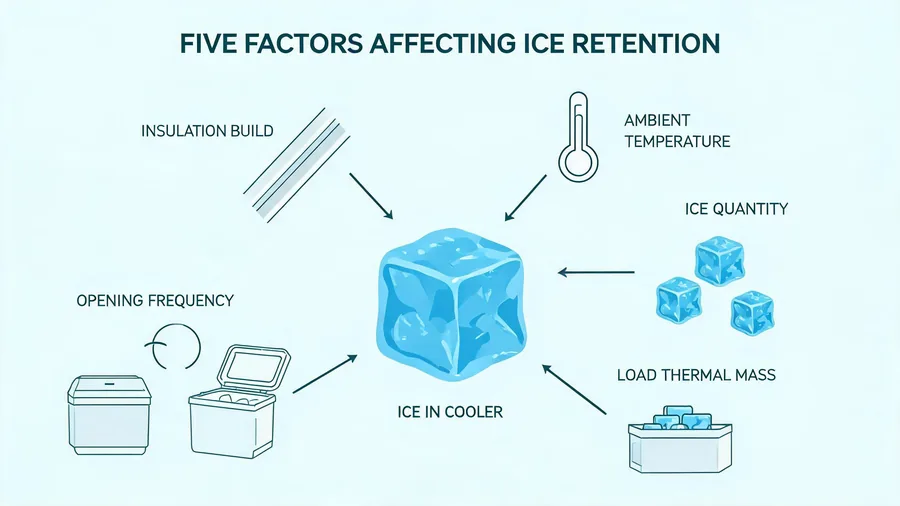
Insulation build. The wall thickness, foam type, and layer continuity set the base rate of heat entry. A thin promotional cooler behaves differently from a food delivery bag built for repeated route stops. More insulation slows heat transfer. It doesn't stop it.
Ambient temperature. A cooler sitting in a 90°F car trunk loses ice faster than the same cooler in a 70°F room. The temperature difference drives the heat flow. Shade matters as much as the bag itself.
How full the cooler is. A full cooler holds cold longer than a half-empty one. The ice has to chill less air. Air exchanges heat quickly. Packed contents hold temperature more steadily.
Opening frequency. Every time you open the lid, warm air replaces cold air. This can dominate real-use loss even when the wall insulation is good. I've seen well-built coolers fail because the lid was opened every ten minutes.
Ice form and quantity. Block ice, cubed ice, gel packs, and dry ice behave differently. The shape and mass of the cold source change how long it lasts. So does the ratio of ice to contents.
Rule-of-Thumb Duration Ranges
These are rules of thumb, not guarantees. Every range below assumes stated conditions. Real performance depends on the tested specification of the bag, the ambient profile, and how the user treats the cooler.
In mild indoor conditions, around 70°F, with a pre-chilled cooler and a full load, cubed ice often lasts roughly 12 to 24 hours. Block ice can stretch that to 2 to 3 days in the same setting. These are the numbers I give buyers who need a starting point. I always attach the conditions.
Outdoors in summer heat, above 85°F, with direct sun and frequent openings, cubed ice may last only 4 to 8 hours. Block ice might hold for a day. A cooler left in a hot car can perform worse than either figure.
Gel packs typically last shorter than block ice but longer than loose cubed ice. They're sealed and denser. Dry ice is a different category entirely. It sublimates rather than melts, and its duration depends on mass and ventilation, not just insulation.
None of these ranges are promises. They're planning numbers. The only way to know a specific cooler's performance is to run a controlled thermal test with a defined payload, refrigerant quantity, ambient temperature, and pass criterion.
Block Ice vs Cubed Ice vs Gel Packs vs Dry Ice
Each cold source has a different mechanism and a different failure mode. The table below compares them for a typical insulated cooler application.
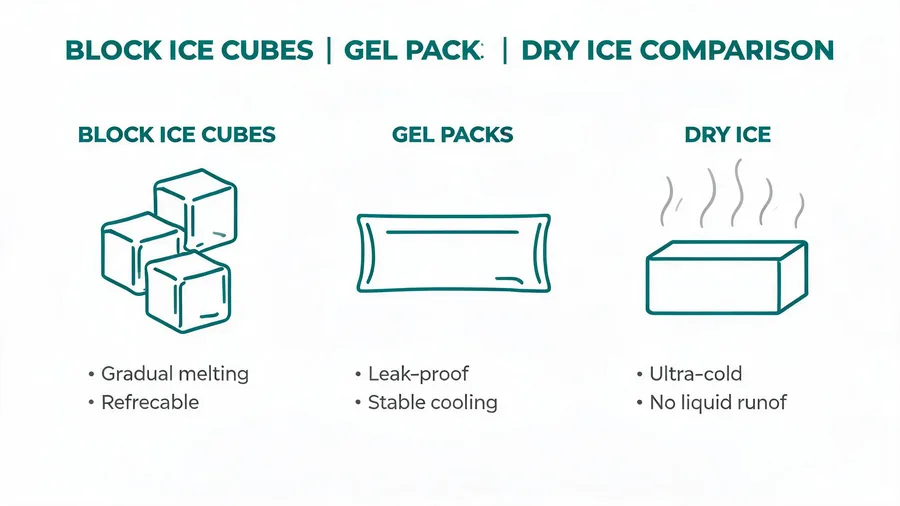
| Cold source | How it works | Typical behavior | Best use |
|---|---|---|---|
| Block ice | Large frozen mass with low surface area relative to volume | Melts slowly; releases cold over a long period | Multi-day trips; stable long holds |
| Cubed ice | Small pieces with high surface area | Cools quickly; melts faster than block ice | Short events; rapid initial chilling |
| Gel packs | Sealed refrigerant packs that warm or change phase | No meltwater; duration depends on pack mass and conditioning | Medical coolers; transport where leakage is unacceptable |
| Dry ice | Solid carbon dioxide that sublimates directly to gas | Extremely cold; no liquid residue; requires ventilation | Frozen shipping; long hauls where moisture is a problem |
Block ice is the workhorse for long holds. Cubed ice chills fast but disappears sooner. Gel packs keep things dry and are common in medical cooler bags where a puddle isn't acceptable. Dry ice is a different animal. I cover it separately below.
Practical Steps That Genuinely Extend Retention
You don't need a better cooler to get more hours. You need better habits. These steps work across bag types, from promotional cooler bags to heavy insulated backpacks.
Pre-chill the contents. Cold contents don't steal cold from the ice. Warm contents do. Put drinks and food in a refrigerator before packing. This is the single highest-impact habit.
Pre-chill the cooler. A warm bag absorbs cold before the contents feel it. Fill the cooler with ice or cold water for an hour, dump it, then pack. Or store the bag in a cold room overnight.
Pack it full. Fill empty space with extra ice, frozen water bottles, or additional contents. Less air means less warm air to cool. A full cooler holds temperature more steadily.
Keep it shaded. Direct sun adds radiant heat on top of ambient heat. Park the cooler in shade. Cover it with a reflective blanket if shade isn't available. A car trunk is an oven in summer.
Limit openings. Plan what you need before opening. One long open is better than five short ones. Consider a separate drinks cooler so the food cooler stays closed.
Think about meltwater. Cold water still holds cold. Draining it removes thermal mass and lets warm air in. Unless the contents must stay dry, leave the meltwater in place until the end.
How the Thermal Layer Stack Actually Works
A cooler bag isn't a single insulating material. It's a stack of layers, each with a job. Understanding the stack tells you where heat gets in and why some bags outperform others.
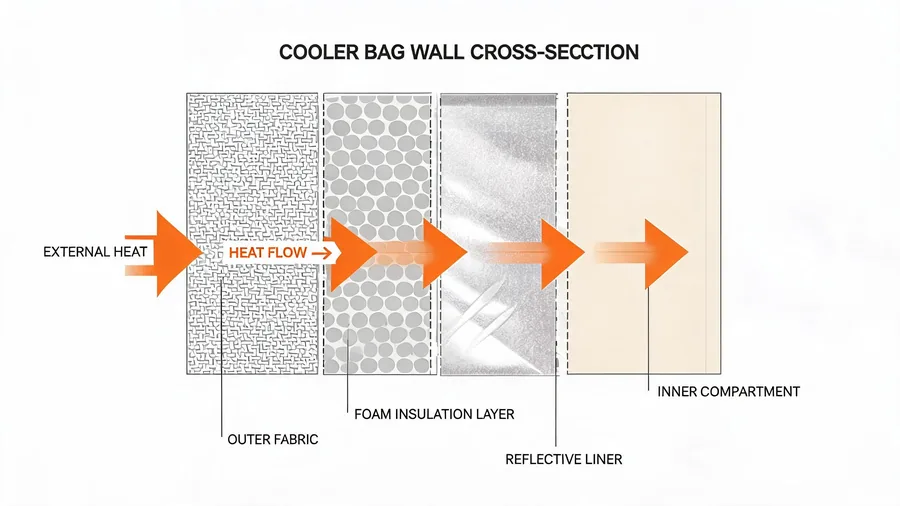
The outer shell provides abrasion resistance, appearance, printability, and initial weather protection. It's not the main insulator. The insulation layer reduces conductive and convective heat transfer. Common forms include closed-cell polyethylene foam and polyurethane foam. Thickness, cell structure, density, and continuity all influence heat-transfer resistance.
A reflective barrier, such as a metallized film or foil-faced layer, can reduce radiant heat transfer when correctly positioned in the construction. The inner liner provides a cleanable interior and may contribute to moisture resistance or liquid containment. The closure system controls air exchange at the opening. Zippers, roll-top closures, and overlapping flaps have different sealing performance.
The refrigerant pack is the cold source. It absorbs heat as the cooling medium warms or changes phase. A smaller air volume and a fuller load generally reduce rapid internal temperature fluctuation. Pre-chilled contents and correctly conditioned refrigerant packs improve cold-hold duration.
Thermal bridges appear where insulation is compressed, interrupted, or replaced by conductive hardware. A zipper. A handle mount. A seam where foam is crushed. These spots leak heat faster than the surrounding wall. Good construction minimizes them. Cheap construction ignores them. For more on how materials affect this, see cooler bag materials.
Dry Ice: A Short Warning
Dry ice isn't a drop-in replacement for regular ice. It's solid carbon dioxide. It sublimates directly to gas, which means no meltwater but also a buildup of carbon dioxide gas. Use it only in well-ventilated areas. Never seal it in an airtight container. The pressure can rupture the container.
Dry ice is also much colder than water ice. It can freeze contents solid and damage some liners or plastics. It lasts longer than water ice under the same conditions, but the duration depends on mass, insulation, and ventilation. For exact hold times, use a dry ice calculator from a reputable supplier. Don't guess. If you're shipping frozen goods, check current guidance from the relevant transport authority before packing.
What to Look for in a Cooler Bag When Retention Matters
When a buyer asks me what to look for, I start with the layer stack. Then I ask about the use case. A food delivery cooler bag on a 30-minute route has different requirements from a insulated cooler backpack on a day hike.
Look for continuous insulation. Check the seams. A bag with thick foam in the panels but thin foam at the zipper will underperform its spec sheet. Ask about the closure type. A roll-top seals better than a zipper. A zipper with a storm flap beats a bare zipper.
Check the liner. It should be cleanable and moisture-resistant. For medical or food use, it must manage condensation without damaging the insulation. Ask whether the bag has been tested for condensation. A cold-loaded bag can pool water internally, seep at seams, or trap moisture in the foam.
Finally, ask for the test method. Any supplier can claim a hold time. The claim means nothing without the ambient temperature, starting temperature, payload, refrigerant quantity, bag size, and pass criterion. If they can't state those, the number is marketing. For more on how to evaluate suppliers, see top cooler bag manufacturers.
Ice retention is a physics problem with a logistics answer. Control the variables, and you control the hours.
FAQ
How long does ice last in a cooler bag?
In mild indoor conditions with a pre-chilled bag and full load, cubed ice often lasts roughly 12 to 24 hours. In summer heat with frequent openings, it may last only 4 to 8 hours. These are rules of thumb, not guarantees.
Does block ice last longer than cubed ice?
Yes. Block ice has a lower surface area relative to its volume, so it melts more slowly. Under the same conditions, block ice can last two to three times longer than cubed ice.
Should I drain the water from my cooler?
Usually no. Meltwater still holds cold. Draining it removes thermal mass and lets warm air in. Leave the water until the end unless the contents must stay dry.
Why does my cooler lose ice so fast in the car?
A car trunk acts like an oven in summer. Ambient temperatures can exceed 100°F, and direct sun adds radiant heat. Pre-chill the cooler, pack it full, and keep it shaded or inside the cabin.