Cooler Material Guide: Shells, Foams, Liners, Closures
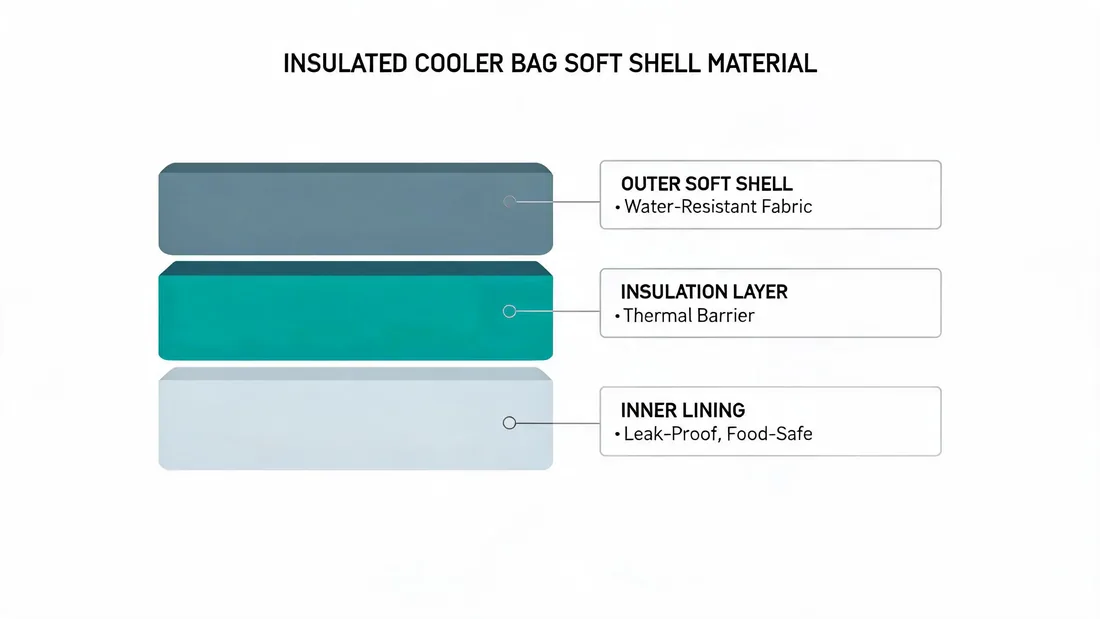
A cooler bag quote can look identical across five factories and perform completely differently in the field. The reason is almost always in the material stack. Two bags can share a silhouette, a logo and a price point, while one holds chilled payload twice as long as the other. If you are comparing supplier quotes for a promotional cooler, a food delivery bag or a medical transport case, the fastest way to cut through marketing language is to read the functional layers one by one.
Every soft cooler is a system of five layers, even when two layers are fused into one sheet. Each layer has a specific job, and each job has a material choice that does it well or poorly. This article walks through that stack: outer shell, insulation, reflective barrier, inner liner and closure. It also covers what a real spec sheet should tell you, and what to ask a factory before you commit to a production run.
The five-layer functional stack
Most cooler bags are built as a sandwich. Understanding the stack makes it easier to spot where a quote is cutting corners. The layers are:
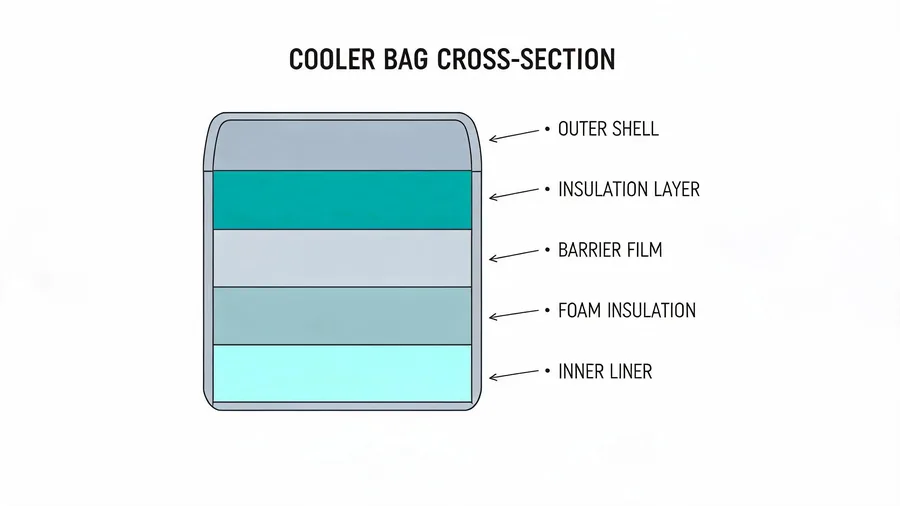
- Outer shell: abrasion resistance, weather resistance, printability and brand surface.
- Insulation core: reduces conductive and convective heat transfer into the payload.
- Reflective barrier: reduces radiant heat transfer when correctly positioned between the outside and the payload.
- Inner liner: cleanable surface, moisture control and leak resistance.
- Closure system: zipper, roll-top or flap. This is the most overlooked thermal weak point.
A cheaper quote usually compresses the stack: thinner foam, no reflective barrier, uncoated outer fabric or an unsealed zipper. Each removed layer saves money and reduces performance. Buyers who know where to look can spot those removals in a sample within minutes.
Outer shell materials: the face and the armor
The shell has three jobs. It protects the insulation from punctures and abrasion. It sheds rain and spills. It carries the print or brand finish. Shell fabric is described by fiber, denier, weave and coating. Denier is the weight of the yarn, not the strength of the fabric, though higher denier usually correlates with more abrasion resistance for the same fiber and weave.
Oxford polyester is the workhorse of promotional and everyday cooler bags. Common grades are 600D and 900D. Oxford polyester prints well, holds up to moderate daily use and keeps cost down. A PVC or PU backing adds water resistance. Uncoated Oxford soaks through quickly and lets water reach the foam.
PVC-coated polyester and tarpaulin bump up durability and weather resistance. PVC coatings at 3000 mm water column or higher make a bag hose-down cleanable. The trade-offs are weight, stiffness and lower breathability. PVC also has a distinctive chemical smell at first and can crack in extreme cold if not properly formulated.
TPU-laminated fabrics are the premium shell choice. TPU lamination can reach 10000 mm or higher waterproofing while staying lighter and more flexible than PVC. TPU resists oils, many chemicals and abrasion, and it welds cleanly. That weldability matters: heat-welded seams can be fully waterproof, while sewn seams need seam tape to approach the same performance. TPU shells appear more in medical, outdoor and high-spec delivery bags.
Canvas and cotton blends are the aesthetic choice. They look premium and take screen printing nicely, but raw canvas is not waterproof and abrades more quickly than synthetic fabrics. A canvas shell needs a coating or liner to perform in wet conditions. It is common in retail-facing and gift cooler bags where brand feel matters more than extreme weather resistance.
Recycled polyester, often called rPET, is the sustainability option. It performs similarly to virgin polyester and can match 600D Oxford performance in many applications. The premium is usually modest, and many buyer procurement policies now request it by default.
| Shell material | Water resistance | Abrasion resistance | Typical use |
|---|---|---|---|
| 600D Oxford polyester, PU coated | Good with coating | Moderate | Promotional, everyday coolers |
| PVC-coated polyester / tarpaulin | High, 3000 mm+ | High | Delivery bags, heavy duty |
| TPU-laminated fabric | Very high, 10000 mm+ | High | Medical, premium outdoor |
| Canvas or cotton blend | Low unless coated | Low to moderate | Retail, gift, brand-led bags |
| rPET recycled polyester | Good with coating | Moderate | Sustainability-focused lines |
Insulation foam: closed-cell PE, XPE and EVA
Insulation is the thermal engine of the bag. The material that dominates soft coolers is closed-cell polyethylene foam, usually 8 to 15 mm thick, often in XPE form. XPE means cross-linked polyethylene: the polymer chains are chemically cross-linked during manufacturing, which creates a finer, more uniform cell structure and better recovery after compression. EVA foam is a softer alternative with good flexibility and shock absorption, common in premium or molded designs.
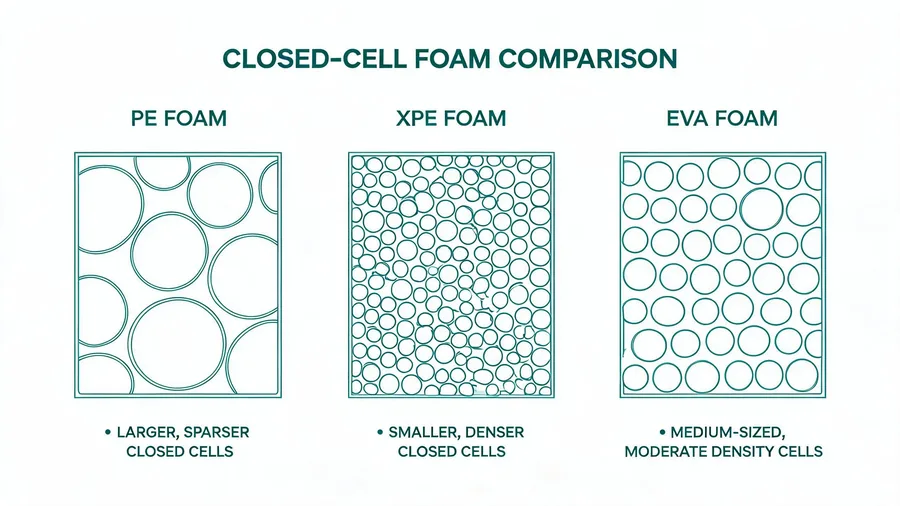
The key distinction is closed-cell versus open-cell. Open-cell foam, like standard upholstery foam, breathes. Air and moisture move through it, making it a poor thermal insulator in a cooler context. Closed-cell foam traps gas inside sealed bubbles, which resists both heat flow and water absorption. That is why a cooler bag that gets wet on the outside should not lose its insulation performance the way an open-cell foam bag would.
Insulation performance of typical closed-cell PE foam runs roughly R-2.5 to R-4 per inch of thickness. An 8 to 15 mm foam layer is only a fraction of an inch thick, so a cooler bag is not a hard cooler. The foam slows heat transfer, but it cannot stop it. Thicker foam within that 8 to 15 mm range usually means a measurable, but modest, gain in hold time, all else equal. Continuity matters more than thickness. If the foam is compressed to nothing at the seams, or replaced by a solid plastic frame piece, heat takes that path instead. This is known as a thermal bridge, and it can undo the benefit of a thick foam core.
When comparing quotes, ask the factory to state the foam type, thickness and density. Density affects both insulation and crush resistance. Low-density foam saves cost but compresses more easily, and a compressed foam layer loses thickness, which loses R-value, exactly where the bag gets squeezed in use.
Reflective barrier: the aluminum PET liner
Heat moves three ways into a cooler: conduction through materials, convection through air movement and radiation from nearby warm surfaces. Most discussion of cooler bags focuses on conduction, but in a soft bag sitting in a hot car or in direct sun, radiant transfer is significant. A metallized film, usually aluminum deposited onto PET, reflects a portion of radiant heat when positioned between the outside environment and the payload.
A correctly specified aluminum PET liner can cut radiant heat transfer by roughly 50 percent, and that can extend chilled hold time by 10 to 20 percent. The important caveat is that this gain is always condition-dependent. In a cool, shaded room, the reflective layer does almost nothing. In a hot car with sun on the roof, it does more. Ambient temperature, sun exposure, load and opening frequency all change the measured benefit. No buyer should treat the reflective layer as a magic fix, but it is one of the cheapest performance upgrades available when the use case involves heat and sun.
Position matters. The reflective surface needs to face the warm side, not sit buried between two foam layers. A common construction order from outside to inside is: shell, insulation foam, metallized film with the shiny side facing outward, then inner liner. If the film is flipped or covered by an air gap on the wrong side, the benefit drops sharply.
Inner liners: PEVA, TPU and condensation control
The liner is the surface that touches food, ice packs and condensation. It needs to be cleanable, leak-resistant and food-safe in many applications. Two materials dominate.
PEVA, polyethylene vinyl acetate, is the standard mid-range liner. It is lightweight, flexible, PVC-free and easy to wipe clean. It suits promotional coolers, lunch bags and light food contact. The limitation is long-term durability under heavy abrasion or very low temperatures, where PEVA can stiffen.
TPU liners are the high-end choice. TPU is tough, flexible in cold conditions and highly resistant to punctures and chemicals. Many TPU liners are also heat-weldable, which allows sealed corners and seams instead of stitched ones. For food delivery, medical transport or anything with liquid payload, a welded TPU liner is a meaningful upgrade.
Condensation control is a liner function buyers often miss. Cold contents pull moisture out of the air inside the bag, and the liner is what determines whether that moisture pools in corners or stays manageable. A smooth, non-porous liner is easier to dry and clean. Some bags add a moisture-wicking layer or channels, but the simplest approach is a wipe-clean non-porous surface and a design that lets the bag air out between uses.
Closures and thermal bridges: the hidden leak
The best insulated body in the world cannot save a bag with a leaky opening. Heat enters through zipper gaps, through the seams where the closure is stitched and through any hardware that pierces the insulation. Zippers are the most common closure, and they are also the most common thermal bridge: the zipper teeth and tape replace insulation with metal and thin fabric, creating a continuous path for heat.
A water-resistant or waterproof zipper reduces that gap substantially. Waterproof zippers use a coated tape and interlocking profile that leaves almost no open aperture. They add cost and a bit of stiffness, but for any bag that claims serious performance, they are worth the line item. Roll-top closures are another strong option, especially for dry bags and medical transport. A roll-top can seal without any zipper at all, eliminating the gap entirely with the trade-off of slower access. Flap closures with hook-and-loop are convenient, but they seal poorly compared with either option.
The other thermal bridge is the seam. Where two side panels meet, the insulation is often cut, compressed or absent. A cheap bag sewn straight through the foam along the seam creates a line of low thermal resistance around the entire bag. Better construction uses welded seams or a foam-insert design that keeps insulation continuous. When inspecting a sample, pinch the seams. If the seam is dramatically thinner than the panel, that is a bridge. It matters more than most buyers expect.
How to read a spec sheet and what to ask a factory
A professional cooler bag quotation should not read like a fashion accessory quote. It should list each layer separately, with material, thickness and treatment. A minimal useful spec sheet includes:
- Outer shell: fiber type, denier, coating or lamination, waterproof rating in mm.
- Insulation: foam type, closed-cell confirmed, thickness in mm, density.
- Reflective layer: presence, material and position in the stack.
- Liner: material, thickness, welded or stitched seams.
- Closure: zipper type, waterproof rating if any, or roll-top construction.
- Testing: any temperature performance claim should state the test method, ambient temperature, starting temperature, load mass, refrigerant quantity and the acceptance temperature limit.
Temperature performance claims are the easiest place for a quote to mislead. A statement like "48 hour cooling" is meaningless without the test conditions. A more honest claim looks like: "In laboratory testing at 25 degrees C ambient, with a 5 kg pre-chilled payload and two 500 g ice packs, internal temperature stayed below 8 degrees C for 6 hours." Buyers should push for that level of detail and treat any hold time that lacks conditions as a rule of thumb only. Real-world hold time also depends heavily on opening frequency, how full the bag is, whether contents were pre-chilled and whether the ice packs were properly conditioned. Smaller air volume and a fuller load reduce temperature fluctuation, because less air needs to be kept cold and less warm air enters when the bag is opened.
Pre-chilling and conditioned refrigerant packs are often the cheapest performance gains available. A bag can only resist heat; it cannot remove heat that is already inside. Starting with warm contents or unchilled packs wastes most of the insulation's work. For longer cold-chain runs, these habits matter more than upgrading from 10 mm to 15 mm foam. The thermal profile of a bag, meaning its internal temperature curve over time, will look completely different when the payload starts cold and the bag is full.
Cold-chain vocabulary is useful when talking to suppliers. Hold time is the duration within a specified temperature range under stated test conditions. Temperature excursion is any period outside that range. Conditioning is preparing refrigerant packs or payload before packing. Payload is the actual cooled product, separate from ice or packs. Using these terms in a quote review signals that you understand where performance claims break down.
What a factory quote should answer directly
Before approving a sample or a production run, ask the factory these questions. The answers will separate a supplier who understands thermal performance from one who just assembles fabric bags.
- What is the exact foam type, thickness and density, and is it closed-cell?
- Is the reflective film included, and where does it sit in the layer stack?
- Are the shell seams welded or sewn? What waterproof rating does the shell carry?
- Is the closure waterproof? What is the tested gap or leakage path at the opening?
- Can they provide temperature test data with stated ambient temperature, payload, refrigerant and acceptance limit?
No bag can perform beyond its material physics. A thin, open-cell foam bag with an uncoated shell and a basic zipper is a lunch sack, not a cold-chain tool. That is fine for some uses, but the buyer should know which product they are buying. The difference between a promotional giveaway and a medical transport bag is written in the layer stack, and the layer stack is written in the spec sheet.
For procurement teams comparing quotes across factories, the material list is also the fairest comparison tool. Price differences are often explained exactly by the stack: a TPU shell and liner with welds will cost more than a PU-coated Oxford shell with PEVA liner and sewn seams. Both can be legitimate products for different jobs. The failure is not choosing the cheaper one; the failure is choosing it without knowing what was removed to hit that price.
More details on material selection and how those choices map to use cases can be found in our guide to cooler bag materials. If you are specifying a run and want to talk through layer options directly, the Camytonc team can help walk a spec sheet from sample to production. Understanding the stack before you sign the quote is the single highest-value step in buying a cooler bag that actually performs.
FAQ
What is the best material for a cooler bag outer shell?
It depends on use. TPU-laminated fabric offers the highest waterproofing at 10000 mm+ and is very abrasion resistant. PVC-coated polyester at 3000 mm+ is a solid heavy-duty option for delivery bags. 600D Oxford polyester with a PU coating is the standard choice for promotional and everyday cooler bags.
Why is closed-cell foam used in cooler bags instead of open-cell foam?
Closed-cell foam traps gas inside sealed bubbles, which resists heat flow and water absorption. Open-cell foam breathes, letting air and moisture move through it, which makes it a poor insulator in cooler bag applications and prone to losing performance when wet.
Does the reflective aluminum liner in a cooler bag actually work?
A correctly positioned aluminum PET liner can cut radiant heat transfer by roughly 50 percent and extend chilled hold time by 10 to 20 percent, but the effect is condition-dependent. It matters most in hot, sunny conditions and does little in a cool, shaded room.
What should a cooler bag temperature claim include?
Any meaningful temperature performance claim should state the test method, ambient temperature, starting temperature, load mass, refrigerant quantity and the acceptance temperature limit. Without these conditions, a hold time claim is only a rough rule of thumb.
Related reading: how long ice lasts in a cooler, how to keep food cold in transit, and insulated cooler bags for breast milk.